

Higher oil prices from the war in the Middle East: assessing the headwinds for euro area growth
Prepared by Johannes Gareis
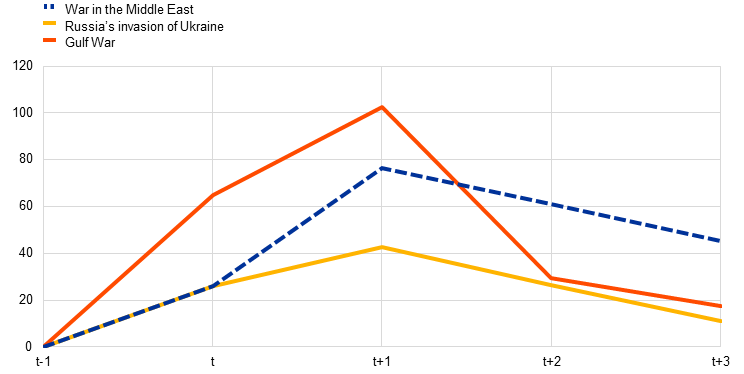
The war in the Middle East has led to a sharp rise in oil prices and is likely to weigh noticeably on euro area economic activity. Following the outbreak of the war in late February 2026, Brent crude oil prices increased markedly, reflecting disruptions to oil flows through the Strait of Hormuz and a decline in oil production in the Middle East. Compared with past major geopolitical oil supply disruptions, the current shock appears to be of intermediate magnitude (Chart A). Although peak oil price levels have been broadly similar to those seen after Russia’s invasion of Ukraine in early 2022, the increase in oil prices triggered by the current shock has so far been larger than the rise observed after the Russian invasion. That shock reflected supply interruptions and heightened uncertainty around Russian oil exports, against a backdrop of persistently elevated oil demand in the aftermath of the COVID-19 pandemic and a much sharper rise in natural gas prices.[1] However, the oil price increase from the current shock is smaller than that observed during the Gulf War in the early 1990s, when Iraq’s invasion of Kuwait removed significant oil supply from the market.
Chart A
Brent crude oil price dynamics around geopolitical oil supply disruptions
(percentage change relative to the quarter preceding the shock)
Sources: U.S. Energy Information Administration (EIA) and ECB staff calculations.
Notes: The chart shows the percentage change in the price of Brent crude oil, based on quarterly averages of monthly US dollar prices. For the war in the Middle East, t corresponds to the first quarter of 2026; for Russia’s invasion of Ukraine, t corresponds to the first quarter of 2022; and for the Gulf War, t corresponds to the third quarter of 1990. The dashed blue line represents the oil price path implied by the June 2026 Eurosystem staff macroeconomic projections for the euro area, which are based on oil futures prices at the cut-off date of 21 May 2026.
The source of these oil price movements is a crucial consideration when assessing their macroeconomic effects. Unlike demand-driven price increases, which typically reflect stronger global growth and support economic activity, supply-driven price increases weigh on activity in oil-importing economies such as the euro area. This operates through higher production costs, lower real household incomes, weaker global demand and elevated uncertainty – with the latter factor typically more pronounced when shocks are geopolitical in nature.[2] This box quantifies the macroeconomic impact on the euro area of the recent rise in oil prices, using an empirical model with identified geopolitical oil supply shocks to assess past and present oil supply disruptions.[3]
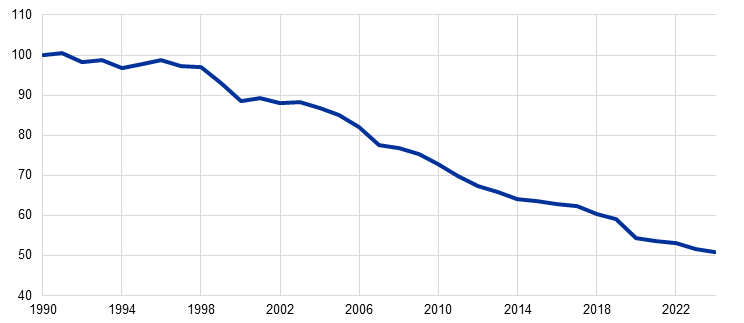
The macroeconomic effects of geopolitical oil supply shocks on the euro area can be assessed using a Bayesian vector autoregressive (BVAR) model. The model includes a series of identified geopolitical oil supply shocks along with the global real price of oil, a global economic activity indicator, euro area real GDP, private consumption, investment, consumer prices, and short and long-term interest rates. The shocks are taken from Verduzco-Bustos and Zanetti (2026) and are constructed using a high-frequency instrumental variable that isolates oil price movements around geopolitical supply disruptions.[4] These shocks are typically associated with sharp increases in oil prices and persistent declines in oil production, making them well suited for analysing the impact of the war in the Middle East.[5] The model is estimated from the first quarter of 1985 to the fourth quarter of 2023.[6] As the oil intensity of the euro area economy has declined steadily since the early 1990s (Chart B), the model is re-estimated over a shorter sample starting from the third quarter of 2003, after the initial phase of the Iraq War, to test whether the transmission of oil supply shocks has changed.[7]
Chart B
Oil intensity of euro area real GDP over time
(index: 1990 = 100)
Sources: Eurostat, New Area-Wide Model database and ECB staff calculations.
Notes: Oil intensity is measured in kilograms of oil equivalent per euro of real GDP and indexed to 100 in 1990. The latest observation is for 2024.
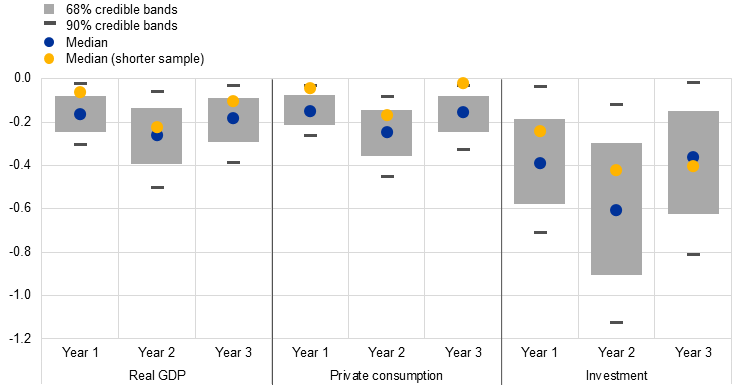
An adverse geopolitical oil supply shock has a persistent negative effect on euro area real GDP growth, operating through both private consumption and investment. Following a geopolitical oil supply shock that raises the real oil price by 10% on impact, euro area real GDP growth is estimated to be around 0.2 to 0.3 percentage points lower in each of the first three years following the shock (Chart C).[8] Both private consumption and investment growth are dragged down, although the effects on investment are more pronounced, since investment is generally more sensitive to the elevated uncertainty that follows geopolitical oil supply disruptions. The subsample estimates for the period since 2003 suggest that the effects may have weakened somewhat over time, owing in particular to a smaller response of private consumption. By contrast, the investment response is broadly stable across subsamples, with the shorter-sample estimates falling within the credible bands of the full-sample response. This may reflect either a less pronounced weakening of the oil intensity channel for investment or an offsetting strengthening of other channels – notably via the heightened uncertainty that geopolitical oil supply shocks entail.
Chart C
Impact on annual growth of an adverse geopolitical oil supply shock
Sources: Verduzco-Bustos and Zanetti (2026), Baumeister and Hamilton (2019), EIA, Bureau of Labor Statistics (BLS), Eurostat, New Area-Wide Model database, ECB and ECB staff calculations.
Notes: The chart shows the estimated impact of a temporary geopolitical oil supply shock that raises the real oil price by 10% on annual growth in euro area real GDP, private consumption and investment in the first three years following the shock. Estimates are reported for the full sample (first quarter of 1985 to fourth quarter of 2023) and for a shorter sample starting from the third quarter of 2003.
The effects of past geopolitical oil supply disruptions – notably the Gulf War and Russia’s invasion of Ukraine – were sizeable in the first year, and the war in the Middle East is estimated to have a broadly similar impact on euro area growth this year. Combining the estimated impulse responses with the estimated shocks makes it possible to quantify the macroeconomic effects of past oil supply disruptions and gauge the impact of the current shock. During the Gulf War and Russia’s war in Ukraine, geopolitical oil supply shocks are estimated to have driven most of the real oil price movements over the first year. Based on the full-sample estimates – which likely provide an upper bound for recent episodes (including the current shock) owing to declining oil intensity – the resulting net drag on GDP growth over the first year amounted to around 0.3 percentage points during the Gulf War and 0.2 percentage points during Russia’s war in Ukraine (Chart D, four-quarter shock). The drag from the initial shock alone was larger. However, oil prices reversed relatively quickly, and the subsequent decline partly offset the initial drag on GDP (Chart D, initial shock). Using the current oil futures curve and assuming that geopolitical oil supply shocks account for most of the implied oil price changes in 2026, the war in the Middle East is estimated to reduce euro area real GDP growth by around 0.4 percentage points over the first year. Unlike in the other episodes, the impact is likely to build up gradually over the year. This reflects the further substantial increase in oil prices expected in the second quarter of 2026 and the more persistent path implied by the futures curve.
Chart D
Estimated first-year impact of geopolitical oil supply shocks on real GDP growth
(percentage points)

Sources: Verduzco-Bustos and Zanetti (2026), Baumeister and Hamilton (2019), EIA, BLS, Eurostat, New Area-Wide Model database, ECB and ECB staff calculations.
Notes: The chart shows the estimated impact on euro area real GDP growth over the first year following the event under two scenarios: the initial shock, capturing only the geopolitical oil supply shock at the start of the event, and a four-quarter shock sequence, capturing shocks materialising over the first full year following the start of the event. For the Gulf War and Russia’s invasion of Ukraine, the shocks are derived from the identified historical shock series. For the war in the Middle East, they are derived from actual oil price developments and the oil futures curve.
Overall, the magnitude of the impact of the current shock is still very uncertain and will depend on the size and persistence of the oil price increase. The effects on activity tend to persist beyond the oil price reversal itself, so even a rapid decline in oil prices would still imply non-negligible output losses in the euro area. Should the shock prove more persistent, the cumulative drag on growth could be larger than the estimates presented here. In addition, broader supply chain disruptions and spillovers to the gas market could further amplify the impact beyond that captured by the historical estimates. So far, however, gas prices have remained relatively resilient, possibly reflecting the limited dependence of Europe on natural gas from the Middle East.
References
Arce, Ó., Battistini, N., Bouabdallah, O., Lis, E. and Mohr, M. (2026), “A tale of two energy crises – initial conditions matter”, The ECB Blog, ECB, 3 June.
Baumeister, C. and Hamilton, J.D. (2019), “Structural Interpretation of Vector Autoregressions with Incomplete Identification: Revisiting the Role of Oil Supply and Demand Shocks”, American Economic Review, Vol. 109, No 5, May, pp. 1873-1910.
Brignone, D., Gambetti, L. and Ricci, M. (2025), “Geopolitical risk shocks: when size matters”, Working Paper Series, No 2972, ECB, May (revised).
Iacoviello, M. and Tong, J. (2026), “The AI-GPR Index: Measuring Geopolitical Risk using Artificial Intelligence”, Working Paper, Federal Reserve Board of Governors.
Känzig, D.R. (2021), “The Macroeconomic Effects of Oil Supply News: Evidence from OPEC Announcements”, American Economic Review, Vol. 111, No 4, April, pp. 1092-1125.
Ferrari Minesso, M., Lopes Mendes, B., Stalla-Bourdillon, A. and Vidaházy, V. (2026), “How US financial markets react to geopolitical shocks hitting oil supply”, Economic Bulletin, Issue 4, ECB.
Mori, L. and Peersman, G. (2026), “Estimating the Macroeconomic Effects of Oil Supply News”, mimeo.
Verduzco-Bustos, G. and Zanetti, F. (2026), “The Effects of Geopolitical Oil Price Shocks”, CESifo Working Papers, No 12606, April.
Legal Disclaimer:
EIN Presswire provides this news content "as is" without warranty of any kind. We do not accept any responsibility or liability for the accuracy, content, images, videos, licenses, completeness, legality, or reliability of the information contained in this article. If you have any complaints or copyright issues related to this article, kindly contact the author above.
